After seven total packages, is the gem the only buy left?
✍️ Alice・愛麗沙

Start by converting “seven packages” into what it actually buys: about NT$6,057, and 21 package points. Not 2,786 — that number is the general cash-shop mileage, a different currency with a similar name, and mistaking one for the other is the most expensive misreading in this whole question. The one-off items in the point shop cost 65 points in total; you have 21. So the real question is not whether to keep buying, it is how to split 21. On raw damage the gem really is the only line: chrysoberyl’s damage-increase +5% lands in the damage-increase bucket, which multiplies the attack-% bucket rather than joining it — and by mid-game the attack-% bucket is already near +80%, so the same 5 points there is worth about 2.8%. But “only the gem” is wrong as stated: the 4-point saddle box is all stats +65, one per character, and buys more per point than the gem does. Its job is arming your alts.
⚠️ The gem value uses a long-standing Korean wiki’s published ladder (5.0/5.2/5.4%); a second community simulator records 3.0% for the base tier. We publish 5% and label the dispute every time it appears. The damage formula is community measurement, not an official publication.
The argument about how many total packages to buy always stalls in the same place: “the fashion and the title are duplicates, so all that is left is points and one gem that gives +5% damage.”
That sentence is correct. What is missing is that nobody attaches the arithmetic to it.
How many points actually arrive
The cumulative reward chain hangs on the count, not the amount spent. Purchase 2 gives the saddle, purchase 5 gives the epic mount, purchase 7 gives whatever that generation puts at the end of the chain.
Points accrue like this:
| Cumulative purchase | Points this time | Running total |
|---|---|---|
| 1 | 1 | 1 |
| 2 | 1 | 2 |
| 3 | 2 | 4 |
| 4 | 2 | 6 |
| 5 | 4 | 10 |
| 6 | 5 | 15 |
| 7 | 6 | 21 |
| 8th onward | 2 each | — |
Seven purchases is 21 points. The one-off items in the shop cost 65.
Two currencies with similar names
Each purchase also refunds 398 cash-shop mileage points. Seven of those is 2,786 — a number big enough to clear the entire point shop, which is exactly why it gets confused for the other one.
They are different currencies. Mileage is a general shop-wide rebate; package points come only from the total package, spend only in the package-point shop, and reset to zero when the generation ends — the notice is explicit that unspent points are deleted and not compensated.
Mistake one for the other and the whole trade-off disappears. It does not disappear. It is tight.
The shape of the shop: 65 against 21
| Item | Package points | Cap | Notes |
|---|---|---|---|
| 金綠柱石 | 10 | 1 | One per character |
| 史詩徽章符文選擇箱 | 10 | 1 | One per server |
| 史詩飾品符文系列選擇箱 | 6 | 1 | One per server |
| 傳令純種馬選擇箱 | 10 | 1 | One per character |
| 稱號:光彩奪目的 | 10 | 1 | One per server |
| 純種馬的馬鞍箱 | 4 | 1 | One per character |
| 每週魔族貢品箱 | 1 | Unlimited | One per server |
| 路易斯服裝袋/托克戰鬥背包/艾拉珠寶袋(每件) | 2 | 1 | One per character |
| 服飾背包/旅行袋/配件背包(每件) | 1 | 1 | One per character |
| 符文重設稜鏡 ×5 | 1 | Unlimited | One per server |
| 興奮動作箱/與花同行動作箱(每件) | 3 | 1 | One per server |
Buying every one-off line costs 56 points in total; seven cumulative purchases pay out 21. The table is a list of trade-offs, not a shopping list.Cash Catalogue
Read the total, not any one row. The shop was never designed to be cleared.
Priced in money it is starker. Spread the whole NT$6,057 across 21 points and one point is about NT$288: the gem at 10 points is roughly NT$2,884, the saddle box at 4 is NT$1,154, a backpack at 1 is NT$288, and a rune reset prism works out at about NT$58 each.
That ruler needs an honest caveat: the seven purchases buy more than points — fashion, a mount, a saddle, a title, a gem. So “NT$288 a point” is a ceiling, not a cost. It is for ordering priorities, not for accounting.
What the gem line actually buys
Two gems are sold for points, and they sit in different slots:
- Chrysoberyl — damage increase +5% (disputed value, see the note above). Weapon slot.
- Green chrysoberyl — +1.5% to every tag (S 2.1%, complete 2.2%). Emblem slot.
“Every tag” is the decisive difference from a Star Prism, and it is calculated below.
The mechanism: why this line and not another
The community shorthand “percent-damage is its own multiplier” points the right way but uses a word that makes people miscalculate.
| Bucket | Content | Stacking | Confidence |
|---|---|---|---|
| A 攻擊力 | 武器基礎攻擊、角色攻擊、刻印、寵物、時裝套裝、固定值附魔全部相加成一個總攻擊;徽章的攻擊%只乘武器那一段 | Adds within its bucket | Confident |
| B 攻擊力% | 所有「攻擊力增加%」的來源,包含裝備、技能、附魔、神器,全部在這一格相加 | Adds within its bucket | Confident |
| C 傷害增加 | 技能威力、增傷詞條、共鳴、神器增傷等相加後,再乘上一個「敵方受傷提升」的子乘區(防具破壞在這裡) | Two nested sub-multipliers | Confident |
| D 強化桶 | 連擊、強擊、廣域、連段、絕招五種強化——彼此相加、各自內部相乘;連擊與強擊共用同一池,只看總和 | Adds within its bucket | Confident |
| E 寶石標籤 | 寶石加成的技能標籤傷害,自成一個乘區,跟傷害增加分開 | Its own multiplier | Fairly confident |
| F 暴擊 | 期望值寫法:1+暴擊率×(暴擊倍率−1);沒有外加%時可化簡成 1+暴擊/10000 | Its own roll-based multiplier | Confident |
| G 無防備 | 只在敵人被破防、進入無防備視窗時才生效;破防極限狀態再乘 1.5 倍 | Its own roll-based multiplier | Moderate |
| H 技能係數強化 | 各職業專屬的技能傷害增益,加法或乘法依來源而定——作者明講要各職自行測試 | Depends on the source | Unconfirmed |
| I 防禦減免 | 1÷(1+敵防×(1−減防率)/14828),雙曲線、永不歸零,沒有固定扣減 | Its own multiplier | Confident |
| J 反擊 | 反擊命中時固定 ×1.1,其餘為 1 | Its own roll-based multiplier | Moderate |
| K 追擊 | 期望值寫法;一次追擊打出該擊的 100%,單發模擬時視為 1 | Its own roll-based multiplier | Confident |
| L 最終傷害增加 | 最外層乘區:最終傷害%、飾品超越、魔導抗性差額都掛在這裡 | Its own multiplier | Confident |
The damage formula the KR community maintains — the operator has never published any combat equation. Its skeleton: values in the same bucket add, different buckets multiply, and the judgement types (crit / defenceless / pursuit) multiply against each other. Taiwan Season 0 runs the same structure. Every constant comes from long-running KR measurement, and two independent implementations agree on the numbers.
One rule: same bucket adds, different buckets multiply.
- Attack-% bucket (B):
B = 1 + Σ(all attack-%). Gear, skills, enchants and artifacts all land in the same addition. - Damage-increase bucket (C): the chrysoberyl bonus goes here, and C is multiplied by B afterwards.
So the same 5 points is worth different amounts depending on where it falls:
- Into the attack-% bucket when you already have +80%: 1.85 ÷ 1.80 − 1 = +2.8%
- Into the damage-increase bucket while it is still empty: 1.05 ÷ 1.00 − 1 = +5.0%
Close to double, and that is the real source of the “only the gem is left” instinct. Not that the gem is strong, but that a full round of spending has already packed the attack-% bucket, so anything added there competes with its own denominator.
One correction to “its own multiplier”, though: chrysoberyl’s 5% is added inside the damage-increase bucket; it is not a multiplier of its own. So its real yield shrinks as that bucket fills — at +30% already in the bucket it is 1.35 ÷ 1.30 − 1 = +3.8%, not 5%. The bucket is independent; this line inside it is not.
560: a bought gem and a rolled gem are different objects
The Star Prism tag pool is 16 options at 6.25% each and a complete prism carries 3 lines. Three lines all landing on the three you named:
1 ÷ C(16,3) = 1 ÷ 560 = 0.179%, so 560 carvings expected
| Stage | Mono gem (each) | Star Prism (all stats / HP) | Tag lines | Damage per tag line |
|---|---|---|---|---|
| Stage 1 (green, Advanced) | +8 | — | — | — |
| Stage 2 S (green, Advanced) | +15 | — | — | — |
| Stage 3 (blue, Rare) | +22 | 22/180 | 1 | ? not published |
| Stage 4 S (blue, Rare) | +29 | 29/250 | 2 | 1.7% |
| Stage 5 (no prefix, Elite) | +36 | 36/320 | 3 | 2.0% |
| Stage 6 S | No mono gem at this stage | ? not published | 3 | 2.1% |
| Stage 7 (final) | No mono gem at this stage | +10 / +180 over Stage 6 | 3 | 2.2% |
Mostly KR player panel transcriptions; the stage-5 all-stats 36 / HP 320 match the Heliodor values Nexon Taiwan prints. Taiwan took Korea's 7/16 gem-alchemy rework on 9/9: mono gems can be crafted up to stage 4 (crude S), and from elite up only Star Prisms can be promoted — elite mono gems you already hold can be converted back into crude gems plus gold.
So buying the gem does not only buy the 5%, it deletes the denominator 560. Chrysoberyl opens at 5% with no tag to roll and no pool to fight. That is a variance, not a stat, and it is the part most often left out of the value calculation.
Green chrysoberyl flips the comparison. It is +1.5% on all tags; a Star Prism’s tag-damage line at full stage is +2.0% but pays only on skills carrying that tag. So the comparison is really about coverage: a class whose main rotation is concentrated on one tag (a frost mage’s elemental tag covers five of six actives, roughly 95% of output on our own estimate, ±10pp) gets about 1.9% from a rolled line and beats the flat 1.5%. A class whose rotation spreads across three tags gets 1.2–1.4% from any single line, and the 1.5% that needs no rolling wins.
The test is one sentence: does your class have a tag above 75% coverage? Yes, roll a prism. No, buy the green one.
Splitting 21 points
First | the three backpacks, 1 point each. The cheapest slots in the shop and one per character. Spend those 3 first and start the real decision with 18.
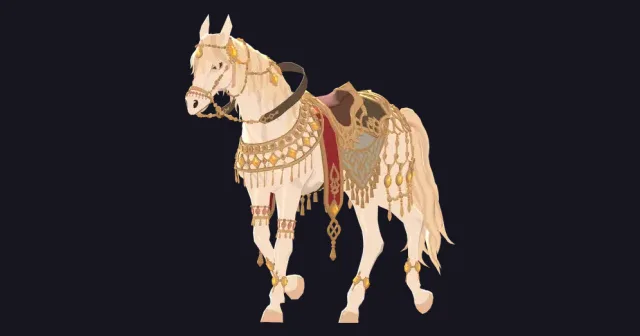
Second | the saddle box, 4 points. All stats +65, and the notice says it applies regardless of which mount is out — the free story horse included. A main who reached cumulative purchase 2 already has one, so these 4 points exist to arm an alt. At 16.25 stat points per package point it is the densest line in the shop.
Third | chrysoberyl, 10 points. The +5% above. It eats 10 of your remaining 18, so buying it ends the list.
Fourth | the epic accessory rune-series box at 6, the epic emblem rune box at 10. Both are self-select, not random, and share one server-wide allowance. Skip if you already hold the matching legendary rune; if you are still on epic runes their expected value is not behind the gem — the difference is that they are a one-time patch and the gem is a standing multiplier.
Fifth | the epic mount box, 10 points. Cumulative purchase 5 already gave you one. Its real yield is gold +8% and charm +3,000; the mount piece works through why buying a mount for stats does not hold in this game.
Last | pour the remainder into rune reset prisms. One point for five, unlimited, the only slot that absorbs an arbitrary balance. Points expire; prisms do not.
So is it only the gem?
Two layers, two answers.
On “make the number bigger”, yes. An account that bought the whole chain has its attack-% and flat-attack buckets stuffed with set effects, runes and imprints — all flat values or same-bucket percentages. The only thing in the point shop that touches a different bucket is those two gems.
On “how much per point”, no. The 4-point saddle and the 1-point backpacks beat the 10-point gem on efficiency. They just are not for your main; they are for the alts, and alts in this game are production capacity rather than collection.
Three conditions that flip the answer:
- Class. A tag above 75% coverage means rolling a prism beats the green gem; a scattered kit means the reverse.
- How crowded your damage-increase bucket is. Empty, the gem yields 5%; at +30% already, 3.8%. It is a mid-game buy, not an endgame one.
- Where gems come from now. The alchemy rework deleted the intermediate fusions and cut the path to a Rough Star Prism S from ten steps to six — farming them yourself got faster, which pushes the relative value of a bought gem down a notch. The tables are in the alchemy rework piece.
What to do
- Backpacks (3) → an alt’s saddle box (4) → 14 left. If your main’s damage-increase bucket is still empty, chrysoberyl (10) and the remainder into prisms.
- If you are late enough that the bucket is crowded, swap the 10 for the epic accessory rune box (6) plus a backpack.
- Zero the balance before the generation ends. Unspent points are not compensated.
- If you do not yet hold a full legendary set or your runes are still below epic, this whole trade-off is a question you do not have yet. The bottleneck is elsewhere.
What would overturn this
- The 5%. Two Korean sources disagree (5.0% and 3.0%). If the in-game item text says something else, in-game wins and every figure above is recomputed.
- The damage formula is community measurement, not an official publication. If “attack-% adds in one bucket, damage-increase is a separate one” is ever overturned, the whole ordering is rewritten.
- The price list is one generation’s. Items and point costs change between generations; when they do, the conversions are redone.
- Tag coverage is our own estimate (±10pp), not a damage-meter measurement.